Use our Fahrenheit to Celsius converter to quickly and accurately convert temperatures from degrees Fahrenheit (°F) to degrees Celsius (°C). Enter a temperature in the calculator below to get the equivalent Celsius value instantly.
Convert Fahrenheit to Celsius
Enter a temperature in degrees Fahrenheit (°F) to instantly calculate the equivalent temperature in degrees Celsius (°C).
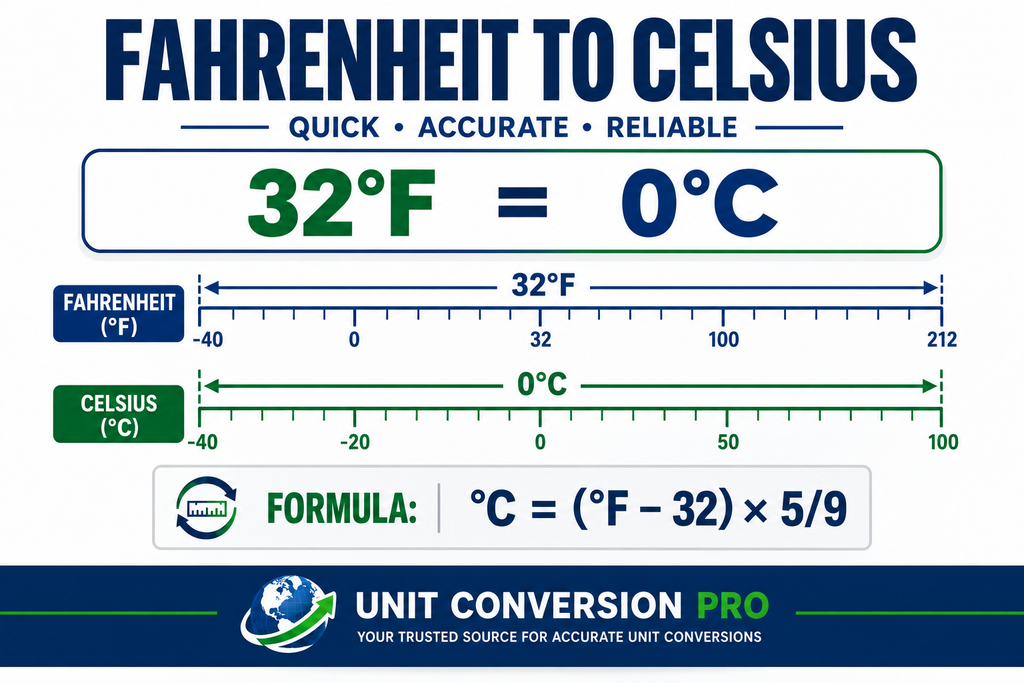
Formula: °C = (°F − 32) × 5/9
How to Convert Fahrenheit to Celsius
To convert Fahrenheit to Celsius, subtract 32 from the Fahrenheit temperature, then multiply the result by 5/9.
Fahrenheit to Celsius Formula
°C = (°F − 32) × 5/9
Example: Convert 68°F to Celsius.
68 − 32 = 36
36 × 5/9 = 20
68°F = 20°C
Fahrenheit to Celsius Conversion Chart
| Fahrenheit (°F) | Celsius (°C) |
|---|---|
| -40 | -40 |
| 0 | -17.777778 |
| 32 | 0 |
| 50 | 10 |
| 68 | 20 |
| 77 | 25 |
| 86 | 30 |
| 98.6 | 37 |
| 100 | 37.777778 |
| 212 | 100 |
| 350 | 176.666667 |
| 400 | 204.444444 |
Common Temperature Reference Points
- −40°F = −40°C — the two scales are equal
- 32°F = 0°C — freezing point of water
- 68°F = 20°C — common room-temperature reference
- 98.6°F = 37°C — commonly cited average human body temperature
- 212°F = 100°C — boiling point of water at standard atmospheric pressure
Frequently Asked Questions About Fahrenheit to Celsius
How do you convert Fahrenheit to Celsius?
Subtract 32 from the Fahrenheit temperature, then multiply the result by 5/9.
What is 32°F in Celsius?
32°F equals 0°C.
What is 100°F in Celsius?
100°F is approximately 37.78°C.
At what temperature are Fahrenheit and Celsius the same?
Fahrenheit and Celsius are equal at −40 degrees.
What is 68°F in Celsius?
68°F equals 20°C.
When to Convert Fahrenheit to Celsius
A Fahrenheit to Celsius converter is useful when comparing weather forecasts, cooking temperatures, scientific measurements, travel information, medical temperature references, and other situations where temperatures are expressed using different scales.
Common Uses of Fahrenheit and Celsius
Fahrenheit and Celsius are used in many everyday situations, but their use varies by location and purpose. Fahrenheit is commonly used for weather forecasts, household temperatures, and cooking in the United States, while Celsius is widely used for these purposes in most other countries. Celsius is also commonly used in scientific, educational, and technical settings. Understanding both temperature scales can be especially helpful when traveling internationally, following recipes from another country, comparing weather information, or working with products and instructions that use a different temperature scale.
About Fahrenheit
Fahrenheit, represented by the symbol °F, is a temperature scale commonly used in the United States. On the Fahrenheit scale, water freezes at 32°F and boils at 212°F at standard atmospheric pressure.
About Celsius
Celsius, represented by the symbol °C, is a temperature scale used throughout most of the world and widely used in science and the metric system. On the Celsius scale, water freezes at 0°C and boils at 100°C at standard atmospheric pressure.
For additional information about temperature units and exact Fahrenheit-to-Celsius conversions, visit the U.S. National Institute of Standards and Technology (NIST).
Understanding the difference between these temperature scales is especially useful when comparing weather forecasts, cooking temperatures, travel information, scientific measurements, and other temperature references from different countries. Fahrenheit is commonly used in the United States, while Celsius is widely used throughout most of the world. An accurate Fahrenheit to Celsius conversion helps ensure that temperatures are interpreted and compared correctly.
For fast and accurate results, use our Fahrenheit to Celsius converter whenever you need to compare temperatures between the two scales.
Convert Celsius to Fahrenheit
Need to convert the other way? Use our Celsius to Fahrenheit converter to quickly convert temperatures from degrees Celsius (°C) to degrees Fahrenheit (°F).
More Temperature Converters
Explore more temperature conversion tools on our Temperature Converters page, or browse our complete collection on the All Converters page.