Convert megabytes to gigabytes instantly with our free, accurate megabytes to gigabytes converter. Enter any value in megabytes (MB) below to get the equivalent amount of digital storage in gigabytes (GB).
Convert Megabytes to Gigabytes
Enter a value in megabytes (MB) to instantly calculate the equivalent value in gigabytes (GB).
Formula: gigabytes = megabytes ÷ 1,000
How to Convert Megabytes to Gigabytes
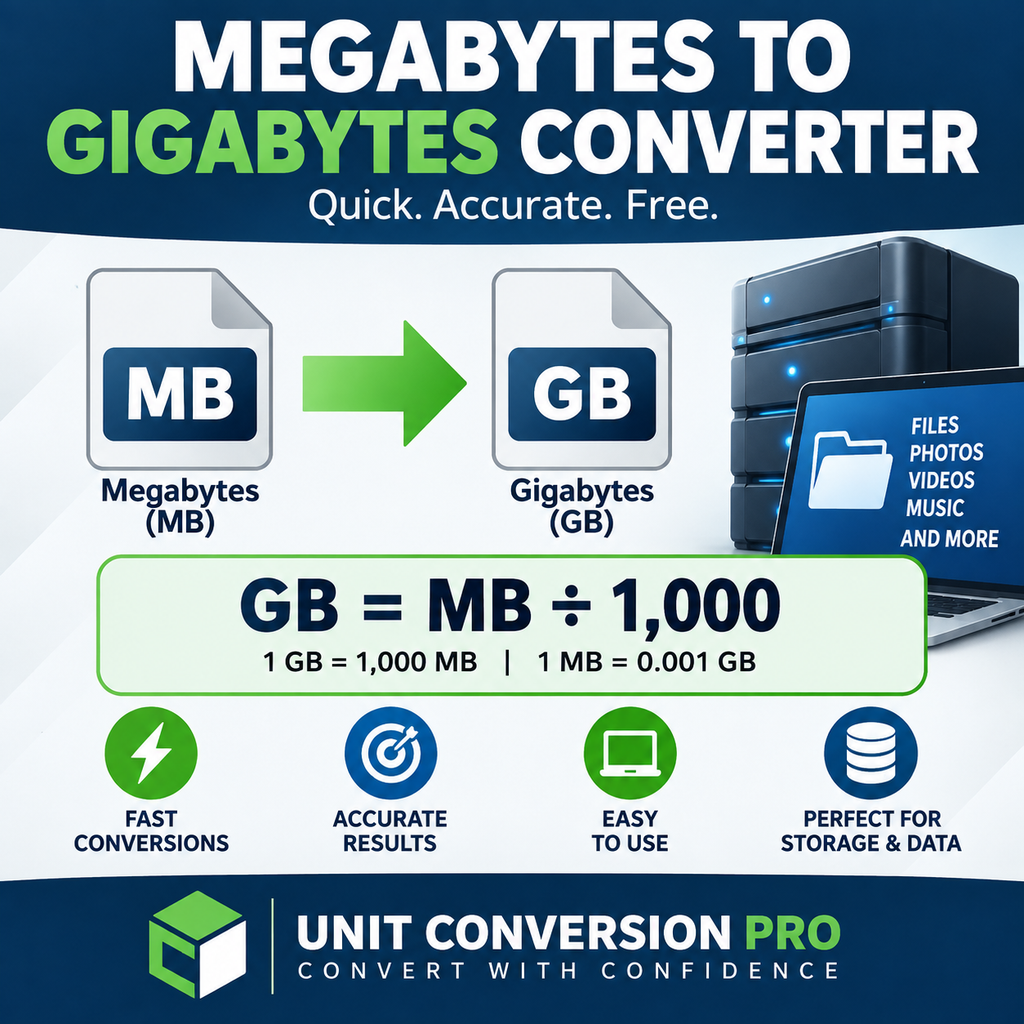
To convert megabytes (MB) to gigabytes (GB), divide the number of megabytes by 1,000.
Formula:
GB = MB ÷ 1,000
Example – to convert 2,500 MB to GB:
2,500 ÷ 1,000 = 2.5 GB
Therefore:
2,500 MB = 2.5 GB
This converter uses the decimal (SI) standard, where 1 GB = 1,000 MB. Binary data units use different terminology: 1 GiB (gibibyte) = 1,024 MiB (mebibytes).
Megabytes to Gigabytes Conversion Chart
| Megabytes (MB) | Gigabytes (GB) |
|---|---|
| 1 MB | 0.001 GB |
| 10 MB | 0.01 GB |
| 50 MB | 0.05 GB |
| 100 MB | 0.1 GB |
| 250 MB | 0.25 GB |
| 500 MB | 0.5 GB |
| 1000 MB | 1 GB |
| 2500 MB | 2.5 GB |
| 5000 MB | 5 GB |
| 10000 MB | 10 GB |
Common Megabytes to Gigabytes Conversions
- 100 MB = 0.1 GB
- 250 MB = 0.25 GB
- 500 MB = 0.5 GB
- 1,000 MB = 1 GB
- 2,000 MB = 2 GB
- 2,500 MB = 2.5 GB
- 5,000 MB = 5 GB
- 10,000 MB = 10 GB
Frequently Asked Questions About Megabytes to Gigabytes
How do you convert megabytes to gigabytes?
Divide the number of megabytes (MB) by 1,000 to convert it to gigabytes (GB).
How many megabytes are in a gigabyte?
Using the decimal standard, 1 GB = 1,000 MB.
How many gigabytes is 500 MB?
500 MB = 0.5 GB.
How many gigabytes is 1,024 MB?
Using the decimal standard, 1,024 MB = 1.024 GB. The commonly encountered 1,024 relationship applies to binary units: 1 GiB = 1,024 MiB.
What is the difference between MB and GB?
Both are units used to express digital data and storage capacity. A gigabyte represents a larger amount of data than a megabyte.
Why do some sources say 1 GB equals 1,024 MB?
This comes from older conventions that often used binary calculations while labeling the units MB and GB. Under standardized terminology, MB and GB use decimal multiples, while MiB and GiB identify the corresponding binary units.
When You Might Need to Convert Megabytes to Gigabytes
Converting megabytes to gigabytes is useful when comparing digital file sizes, storage capacity, downloads, uploads, and data usage. You may need this conversion when:
- Comparing computer, smartphone, or tablet storage
- Checking the size of photos, videos, music, or other files
- Estimating how much space a collection of files will require
- Comparing cloud-storage plans
- Monitoring mobile or internet data usage
- Evaluating software or game download sizes
- Planning storage for video, photography, or other digital media
Our megabytes to gigabytes converter makes it easy to translate digital storage measurements from MB to GB quickly and accurately. Our megabytes to gigabytes converter is especially useful when you need a quick MB to GB calculation without performing the conversion manually.
About Megabytes and Gigabytes
Megabytes (MB)
A megabyte (MB) is a unit used to measure digital information and storage capacity. Under the decimal convention used by this converter, 1 MB equals 1,000,000 bytes. Megabytes are commonly used to describe file sizes, photographs, audio files, documents, software downloads, and smaller amounts of digital storage.
Gigabytes (GB)
A gigabyte (GB) is a larger unit of digital information and storage capacity. Under the decimal convention, 1 GB equals 1,000 MB, or 1,000,000,000 bytes. Gigabytes are commonly used to describe the storage capacity of computers, smartphones, memory cards, drives, software, and larger digital files.
1 MB = 0.001 GB.
For additional information about metric measurement and SI units, visit the U.S. National Institute of Standards and Technology (NIST).
Understanding the difference between decimal and binary digital-storage units is important when comparing storage capacities and file sizes. This converter follows the decimal convention, where 1 GB = 1,000 MB. Binary units use different names: a mebibyte (MiB) and gibibyte (GiB), with 1 GiB = 1,024 MiB. Recognizing this distinction can help explain why storage measurements may sometimes appear different across operating systems, software, and hardware specifications.
Using our megabytes to gigabytes converter also helps keep your calculations consistent with the decimal MB and GB standard used throughout this page.
For fast and accurate results, use our megabytes to gigabytes converter whenever you need to compare digital storage or data measurements between megabytes (MB) and gigabytes (GB).
Convert Gigabytes to Megabytes
Need to convert gigabytes back to megabytes? Use our Gigabytes to Megabytes Converter to calculate the equivalent amount of digital storage in megabytes (MB) from gigabytes (GB).
More Data & Digital Storage Converters
Explore more digital measurement tools in our Data & Digital Storage Converters collection, or browse All Converters.